Leave Your Message
Buying a Chicken Harvester for international poultry operations requires more than comparing prices and engine power. Buyers must examine field capacity, bird comfort, labor needs, road access, maintenance support, and regional climate. A machine that performs well on a large, flat farm may struggle on wet ground or narrow lanes.
Temple Grandin, a recognized livestock-handling authority, has said, “People are more important than equipment.” This principle matters when selecting a Chicken Harvester. Operators need clear controls, safe access points, and practical training. Gentle collection can also reduce bird stress, bruising, and avoidable losses during loading.
This guide examines key purchasing details for global buyers. It considers harvesting speed, adjustable working systems, cleaning requirements, fuel use, spare-part availability, and after-sales service. Local technicians matter. So does documentation in a usable language.
Do not trust impressive brochures alone. Ask for field records, maintenance schedules, warranty conditions, and customer references. Inspect how the machine handles uneven litter, crowded sheds, and sudden stoppages. These details reveal more than a polished product photograph.
There is no perfect model. A highly automated harvester may reduce labor but increase repair complexity. A simpler unit may be easier to maintain but slower during peak periods. Buyers should calculate the full operating cost, not only the purchase price.
This article offers a practical framework for comparing suppliers and specifications. Some recommendations may require adjustment after local testing. That is an important limitation. Real farm conditions can expose weaknesses that laboratory demonstrations never show.
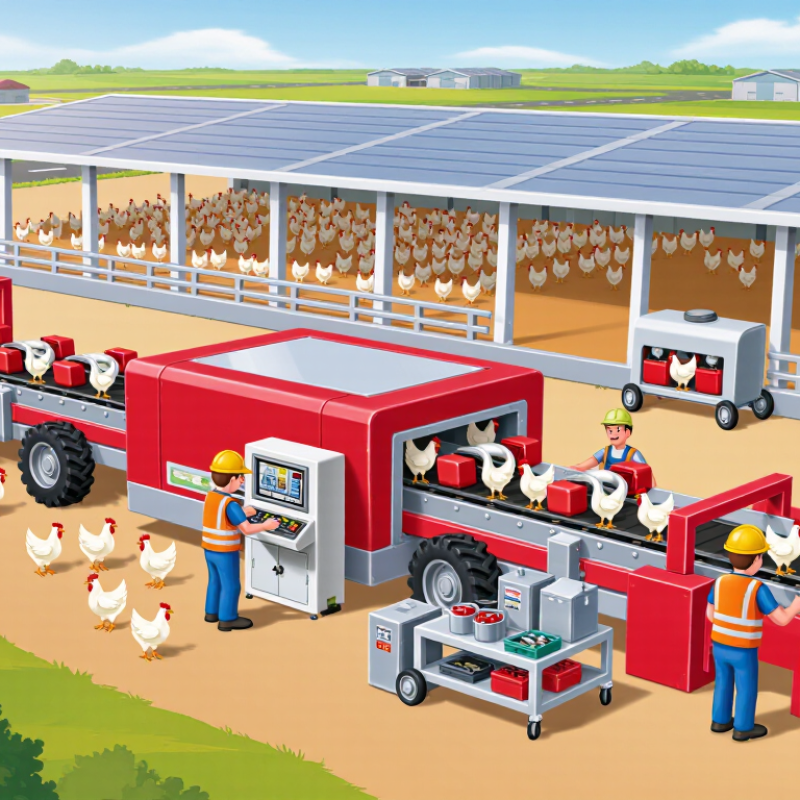
A chicken harvester is a machine designed to collect broiler chickens efficiently inside poultry houses. It usually combines a catching unit, soft conveyor belts, an inspection area, and a transfer system. Instead of relying entirely on manual handling, the machine guides birds toward crates or transport containers. This can reduce walking distance, loading time, and physical strain on workers.
The process begins with adjustable intake fingers or belts moving birds gently from the floor. Low-pressure guides help prevent sudden escapes and crowding. A conveyor then carries the birds at a controlled speed. Operators monitor the flow through viewing panels and control switches. Sensors may detect blockages or irregular movement. Small adjustments matter. Excessive speed can increase piling and stress.
In practical use, floor conditions, bird size, house layout, and lighting affect performance. A harvester that works well in one building may need different settings elsewhere. Buyers should examine belt width, cleaning access, emergency stops, power requirements, and spare-part availability. Ask for real operating data, not only advertised capacity. During a site trial, observe feather condition, leg handling, noise, and operator visibility. Records from previous farms can reveal weaknesses that brochures often miss. No machine is perfect. Poor training or rushed settings can still create avoidable problems.
| Data Dimension | Typical Specification or Fact | How It Works | Buying Considerations for Global Buyers |
|---|---|---|---|
| Definition | A chicken harvester is agricultural equipment designed to collect live broiler chickens from poultry houses and transfer them into transport crates or containers. | Moving belts, guided collection systems, or trained operators gently direct birds from the floor into a loading system. | Confirm that the machine is intended for live-bird collection rather than processing, slaughtering, or carcass handling. |
| Main Application | Commercial broiler catching before transport to a processing facility. | The equipment gathers birds, reduces manual handling, and loads them into suitable transport modules. | Match the harvester to flock size, house layout, catching schedule, and the transport system used by the processing plant. |
| Common Harvester Types | Mechanical belt harvesters, semi-automatic catchers, and modular conveyor-based systems. | Mechanical systems use powered belts or collection heads; semi-automatic systems combine machine movement with operator positioning. | Mechanical systems may improve consistency, while semi-automatic models can be more adaptable in smaller or irregular houses. |
| Typical Collection Capacity | Approximately 4,000–12,000 birds per hour, depending on bird size, machine design, house conditions, and operator experience. | Birds are continuously transferred to crates or containers while the machine advances through the poultry house. | Use the lower end of the range for planning. Actual throughput should be verified through an on-site or comparable-farm test. |
| Suitable Bird Weight | Commonly designed for broilers weighing about 1.5–3.5 kg per bird, although the allowable range varies by model. | Collection openings, belt speed, and handling surfaces are adjusted to accommodate the target bird size. | Check the manufacturer's stated bird-weight range and ensure it matches the production cycle used on the farm. |
| Labor Requirement | Usually requires a smaller operating crew than fully manual catching, but operators are still needed for supervision, positioning, crate handling, and safety. | Automation performs the repetitive collection task while workers control the machine and manage the loading process. | Calculate total labor needs, including machine operators, crate logistics, maintenance staff, and loading personnel. |
| Typical Drive System | Electric, hydraulic, or diesel-powered drive systems are used in different equipment configurations. | The drive system powers movement, conveyors, collection belts, fans, or hydraulic components. | Consider local fuel availability, electrical supply, emissions requirements, maintenance skills, and operating cost. |
| Power Requirements | Electric systems may require a stable three-phase supply; mobile systems may use an engine or a tractor-assisted power source. | Power is distributed to traction motors, conveyors, lifting mechanisms, and control systems. | Verify voltage, frequency, phase, plug standards, generator capacity, and site access before ordering. |
| House Compatibility | Many systems are designed for long, flat broiler houses with sufficient aisle width and unobstructed access. | The harvester travels along the house floor while collecting birds from a defined working path. | Measure door width, interior height, aisle width, floor slope, obstacles, ventilation equipment, and turning space. |
| Floor Conditions | Best performance is generally achieved on firm, level, dry, and reasonably clean floors. | Stable floor conditions help maintain traction and reduce uneven movement during collection. | Wet litter, deep litter, excessive dust, or uneven concrete can lower capacity and increase bird-handling risks. |
| Collection Method | Most modern systems use low-speed belts, guided intake sections, or enclosed transfer areas to reduce direct lifting. | Birds move from the floor to the conveyor and then into crates or containers with controlled transfer points. | Evaluate belt texture, transfer height, pinch-point protection, adjustability, and ease of cleaning. |
| Bird Welfare Features | Useful features include adjustable belt speed, smooth transfer points, protective guards, low drop heights, and reduced compression. | Controlled movement reduces unnecessary lifting, rough contact, overcrowding, and accidental injury during catching. | Request welfare-related operating instructions and confirm compliance with the regulations of the destination market. |
| Crate or Container Interface | Systems may discharge birds into standard poultry crates, drawer-style modules, or transport containers. | A discharge conveyor or transfer section aligns the collected birds with the transport equipment. | Confirm container dimensions, loading height, maximum loading rate, and compatibility with existing transport equipment. |
| Adjustable Operating Speed | Variable-speed control is preferable because bird size, density, litter condition, and loading requirements change between flocks. | Operators adjust conveyor and travel speed to maintain a steady flow without excessive crowding. | Choose a system with accessible controls, emergency stops, and clear speed settings for different operating conditions. |
| Cleaning and Hygiene | Food-production environments require regular removal of feathers, litter, manure, and organic material from machine surfaces. | Washable surfaces, drainage points, removable guards, and accessible components simplify sanitation. | Check water-resistance ratings, cleaning procedures, corrosion protection, drying requirements, and sanitation compatibility. |
| Maintenance Points | Routine maintenance commonly includes belt inspection, lubrication, chain or roller checks, fastener inspection, and electrical-system testing. | Preventive maintenance keeps moving parts aligned and reduces unplanned downtime during time-sensitive harvest operations. | Ask for spare-parts lists, maintenance intervals, service manuals, troubleshooting procedures, and technician training. |
| Safety Equipment | Recommended features include emergency-stop switches, protective guards, audible alarms, non-slip access areas, and overload protection. | Safety systems stop or isolate moving components when an unsafe condition is detected. | Review applicable machinery-safety requirements and ensure operators receive documented training before use. |
| Transport and Mobility | Harvesters may be self-propelled, towable, tractor-assisted, or designed as modular units for relocation. | Mobility systems allow the equipment to move between poultry houses or production sites. | Consider road regulations, loading dimensions, turning radius, storage space, and the cost of relocation between farms. |
| Expected Benefits | Potential benefits include more consistent catching, lower manual labor demand, improved scheduling, and reduced physical strain on workers. | Mechanized collection standardizes the movement of birds and can shorten the catching window when properly operated. | Measure benefits against purchase price, utilization rate, labor savings, maintenance, training, and facility modifications. |
| Key Limitations | Performance may decline in houses with narrow access, uneven floors, heavy litter, obstacles, or unsuitable crate layouts. | The machine depends on adequate space, correct setup, trained operators, and coordinated transport logistics. | Complete a site survey before purchase and calculate the cost of required building, electrical, or flooring improvements. |
| Recommended Evaluation Method | Compare technical specifications, conduct a practical demonstration where possible, and calculate total ownership cost. | A structured evaluation tests capacity, bird handling, operator workload, cleaning time, and compatibility with farm operations. | Use measurable criteria such as birds per hour, labor hours per flock, downtime, cleaning time, and verified welfare performance. |